How We Got Here
As media fragmented, we lost the common notion of what America means. Now we have competing stories, one that focuses on White men, and one that includes everyone.

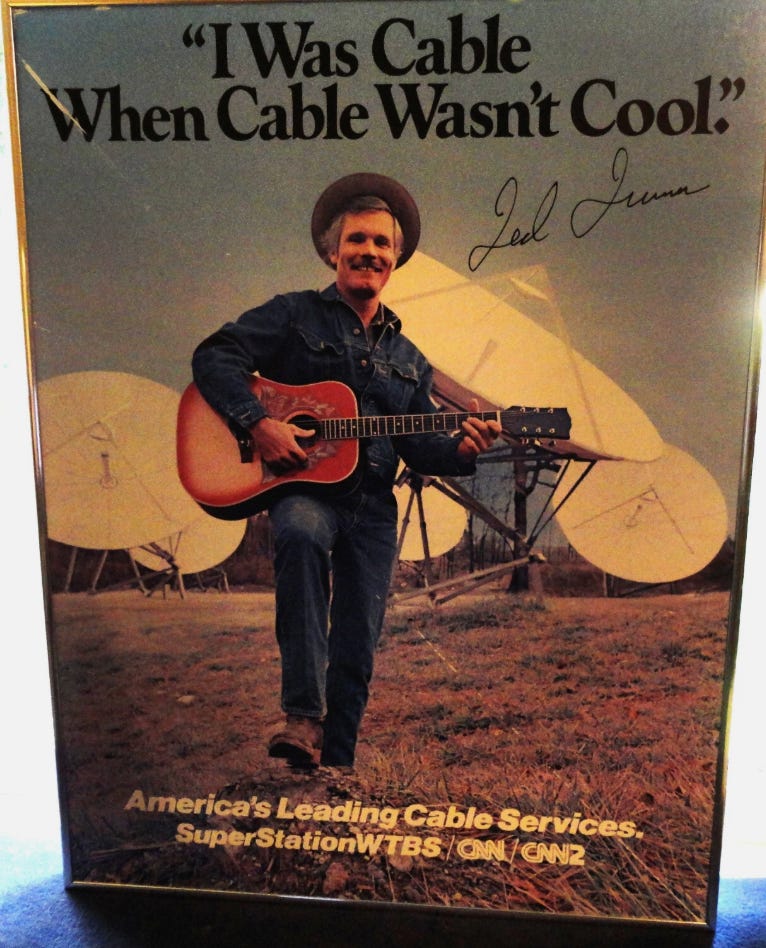
It all started in Atlanta with Ted Turner and Lee Abrams.
Turner inherited WJRJ, the low-powered signal on Channel 17 in the UHF band. Pre-cable, which leveled the playing field, UHF was the red-headed step-child of the more powerful VHF band. Saturday morning pro-bowling and Big Time Wrestling (the precursor to WWE and others that constitute the billion-dollar phony wrestling industry) were relegated to the hinterlands of UHF.
When Turner’s depressed father took his own life, Ted was left with a barely profitable billboard company, and the unprofitable television station. Faced with financial ruin, he had the inspiration to create Turner Broadcasting Systems and turn WJRJ into WTBS, and make it a “Super Station” that the nascent cable television industry could download off the satellite for ready-made content. From Andy Griffith reruns to Atlanta Braves baseball.
Before long, all kinds of content companies were supplying programming to the new cable industry. ESPN, Turner’s CNN, and HBO all exploded nationally, and the television industry fragmented from three networks to hundreds of specialty channels for viewers interested in heretofore unprofitable niches.
Also in the mid-Seventies, Lee Abrams, a twenty-year old prodigy, decided that little pop confections like “Yummy, Yummy, Yummy, I’ve Got Love In My Tummy” had no place on the same stations as “serious” artists like The Beatles, The Rolling Stones, and Led Zeppelin. Abrams convinced ABC execs to let him try a “formatically pure” approach on an underperforming FM station, and the race to fragment radio was on.
Ted Turner and Lee Abrams started the revolution, and technology continued it.
Over the decades, terrestrial radio gave way to satellite radio and music streamers like Pandora and Spotify. Having lost ground to cable, TV broadcasters watched profit margins shrink at the hands of streamers like Netflix. The days of culture-wide hit programming were over. Today, only live sporting events deliver the boxcar-sized audiences the networks were used to. Even that hold is slipping as baseball and football games now appear on the streamers, denting the last big profit point for broadcasters.
The Regulatory Riddle
Recognizing the potential power and reach of broadcasting, Congress created The Federal Communications Commission in 1934 to police the public airwaves. They feared that unscrupulous people might use the broadcast spectrum for political gain, or worse, to subvert our democracy by having malevolent broadcasters dominate what became known as “share-of-voice” with anti-American propaganda.
The regulatory solution was to cap the number of stations any entity could own, and to demand equal time for all opinions. The Reagan administration did away with equal time requirements, saying they were rendered unnecessary by the explosion of cable outlets.
Arguing that the explosion of alternative sources like YouTube and streaming obviated the need for ownership restrictions, the big operators got the FCC to lift the caps. Local operators couldn’t compete, so they sold out to the consolidators: Grey, Sinclair, Nexstar, and TEGNA. These companies now have an outsized share-of-voice:
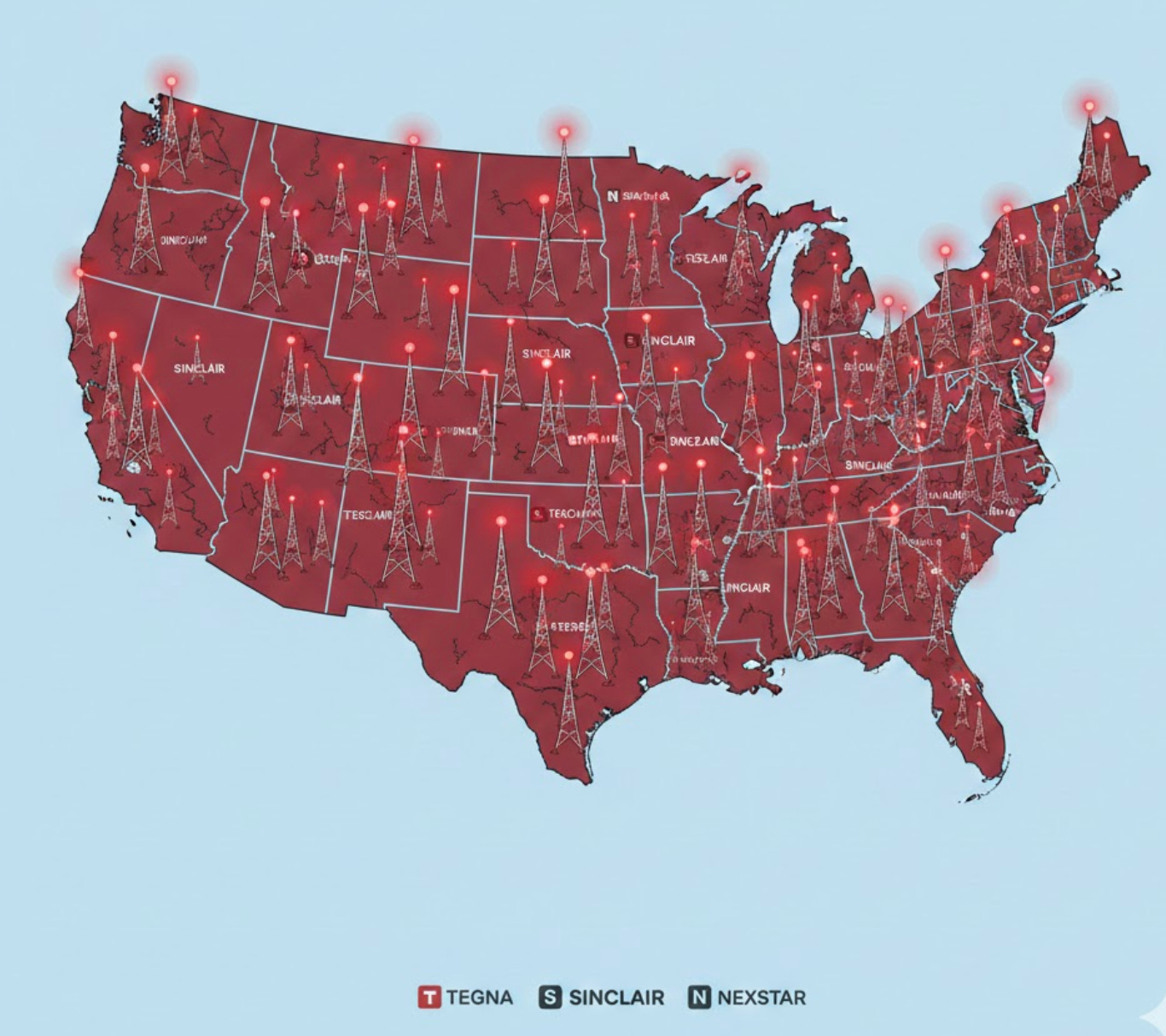
Chris Ruddy, CEO of Newsmax, a smaller right-wing platform, testified before the U.S. Senate Commerce Committee, saying: “This merger would create an unprecedented and dangerous consolidation within the broadcast TV industry, giving them immense control over local news and political news coverage. ... When you raise the national ownership cap, you are effectively saying that two or three corporations should eventually own most or all television stations in America—and by extension, control local news. That is what consolidation truly means.”
According to Pew Research, 64% of us get our news from local stations. Of the four big consolidators, Sinclair and Nexstar are highly political operators with a clear right-wing bent. Sinclair writes extreme editorials and feeds them to the group. Their local stations are local in name only. They air provocative, right-wing national political messages. “Localism,” once the greatest civic component of TV stations, has given way to abject propaganda. Viewers are never informed that their trusted local anchor is reading from a national script.
Now, Nexstar wants to bulk up further with the purchase of TEGNA’s 64 stations. The president has endorsed it, and the FCC is going along. Fragmentation is the excuse. The Wall Street Journal opines that this is good for competition, but broadcast competing with streaming is comparing apples and oranges. It is purely and simply a play for political leverage.
We must bear in mind the important statistic here: two-thirds of Americans get their news from local TV which is quickly losing its localness. That number jumps to 78% of seniors 65+. Pew reminds us that local TV news is currently ranked as the most trusted and “unbiased” news source by Americans (88% for local broadcast news), outpacing national networks and social media.
Sen. Ted Cruz (R-Cancun) is chairing a hearing into media ownership rules. Even he thinks abandoning the caps is foolhardy.
Also opposed to the FCC’s desire to give right-wing broadcasters all the stations they want is former Republican Commissioner Michael O’Reilly: “Congress intentionally and permanently blocked local broadcasters from holding or controlling licenses with a collective national audience reach above 39 percent. Arguments suggesting otherwise or trying to bypass this prohibition lack factual basis or value. Local broadcasters’ only recourse—good or bad—is to advocate for Congress to amend the law.”
©2026 Jon Sinton
Well said. It's a simple concept. Public access to different news and perspectives. Monopolies harm business. Competition is healthy. Caps should be bipartisan. Instead, we are seeing a clear effort to take control of local and national media. They must have control to save us from Bad Bunny...
We lived through it. I wouldn’t be surprised if what you have written, weren’t a true revelation to those in college today studying broadcasting journalism and news. Like a frog in a pot of ever increasing hot water this media consolidation creep has turned up the noise over generations. Broadcast towers are still erected, but the babble that comes through them tumbles down and you don’t need an antenna to know which way the air blows.
The proliferation of choices is like saying the whole aisle in the 7-Eleven that is stocked by Frito lay products gives you a choice of so many different snacks all extruded out of the same machine.
Cable gave us HBO and Lee gave us XM, but that started as something only the wealthy could pay for. Now the subscription model is in everything.
But the real game changer, was Tivo.
Time shifting changed everything. And then streaming. Now it’s all stored and repeated anytime anywhere.
Of course, the danger is when the over the air companies also have streaming platforms and then verge with the tech, Giants and that’s just a matter of vertical integration of information and entertainment and the convenient babble of social media. If it happens today, it might be news to us, but to the news people it’s just another way of selling listeners to advertisers and shoveling profits to stockholders. We are solidly in the era where we don’t watch TV but the TV watches us.
A small parallel would be when the people that had the equipment made the movies and then owned the movie houses. They tore apart that Monopoly. But now the same kind of thing is happening again. It’s organic. Ideas start out small and then they went to organize and then they become organizations and then they become powerful organizations.
And we at the tail end no longer become observers or listeners or even audience. We become “consumers “because we use up what is being fed to us and spit it out again. Not even customers. That would make us human. Just numbers. Just consumers. Like a car, consumes gas until you pay to fill it up again. And we’re breathing our own exhaust.