Tariffs
Crisis? What Crisis?

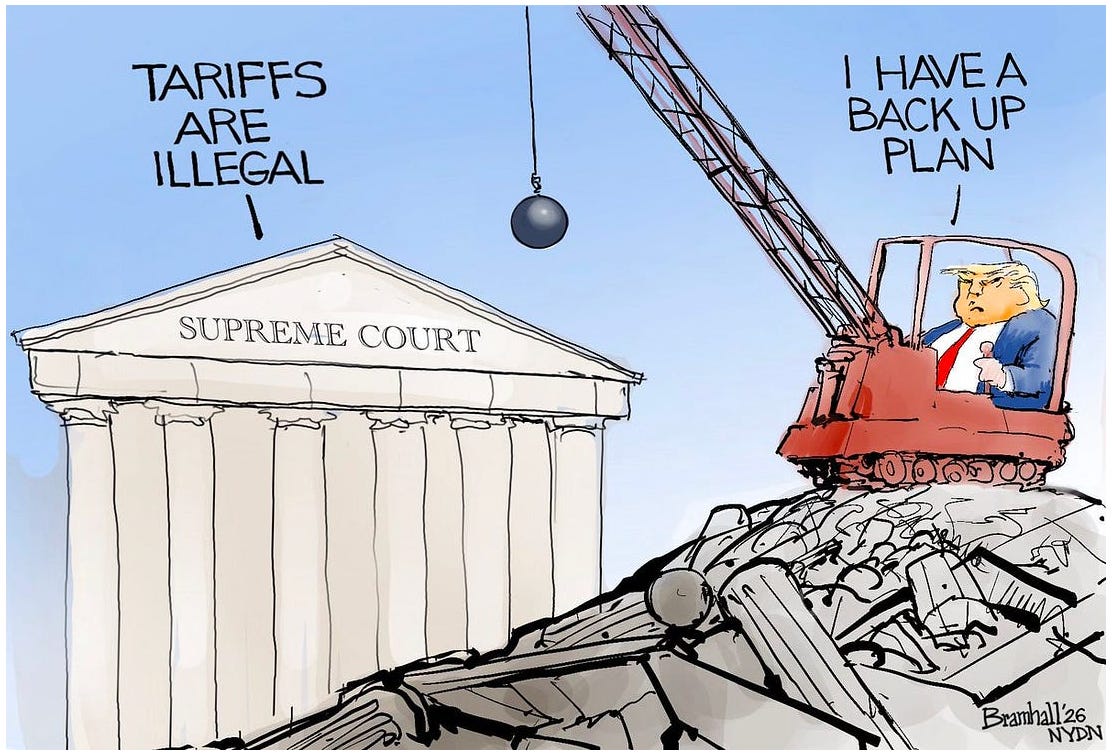
Andrew McCarthy, in Reason Magazine, says the new Trump tariffs are just as verboten as the first round that the Supreme Court struck down last week. Not exactly a bastion of liberal thought, Reason is the voice of Libertarians. Back in the day, Libertarians were referred to as Republicans who got busted for pot. Then weed became legal, thanks in part to Libertarians who believe in small government that doesn’t intervene in citizen’s private lives, and Libertarians continued to rail against what is in their minds, a far too powerful federal government.
McCarthy, who Reason calls a “prominent conservative legal commentator,” outlined the case against Trump’s latest tariff power grab. In brief, and I’ll try to stay out of the weeds (no pun intended) here since the legal arguments can get rather arcane. It is, according to Constitutional scholars like McCarthy, overreach, just like the previous rationale which invoked the International Emergency Economic Powers Act (IEEPA) as rationale for tariffs. In their 6-3 decision that crossed ideological lines, the majority ruled that since no international economic crisis existed, the tariffs were illegal. (No one bothered to cite the habitual declaration of emergencies that this administration uses as excuses for its various extra-legal activities.)
The new 10% tariffs—that quickly became 15%—rely on Section 122 of the Trade Act of 1974. Here’s McCarthy: “In Section 122, Congress endowed the president with narrow, temporary authority to impose tariffs ‘to deal with large and serious United States balance-of-payments deficits’ (Reason’s emphasis). What Trump is complaining about —yet another thing he insists is a crisis but is not—is the balance of trade, not of payments. The United States does not have an overall balance of payments deficit, much less a large and serious one...our overall payments are in balance. There is no crisis.” (It’s actually quite interesting, and while still sparing less interested readers the details, suffice it to say, the law was enacted when the dollar was still tied to gold, and contributes to the idea that Section 122 has even less legal relevance than did using the fig-leaf of the IEEPA.)
The following groups are expected to be the primary plaintiffs:
The Coalition of Small Businesses; major corporations like COSTCO, ALCOA, and Revlon; the same group of twelve states that were plaintiffs in the IEEPA suit; and, associations representing the beverage, electronics, and automotive industries (all heavily hit) are consulting with counsel to file suit in the U.S. Court of International Trade (CIT).
It will be interesting to see how long it takes these cases to get to SCOTUS, and whether the High Court will again take a full consumer-punishing year before ruling.
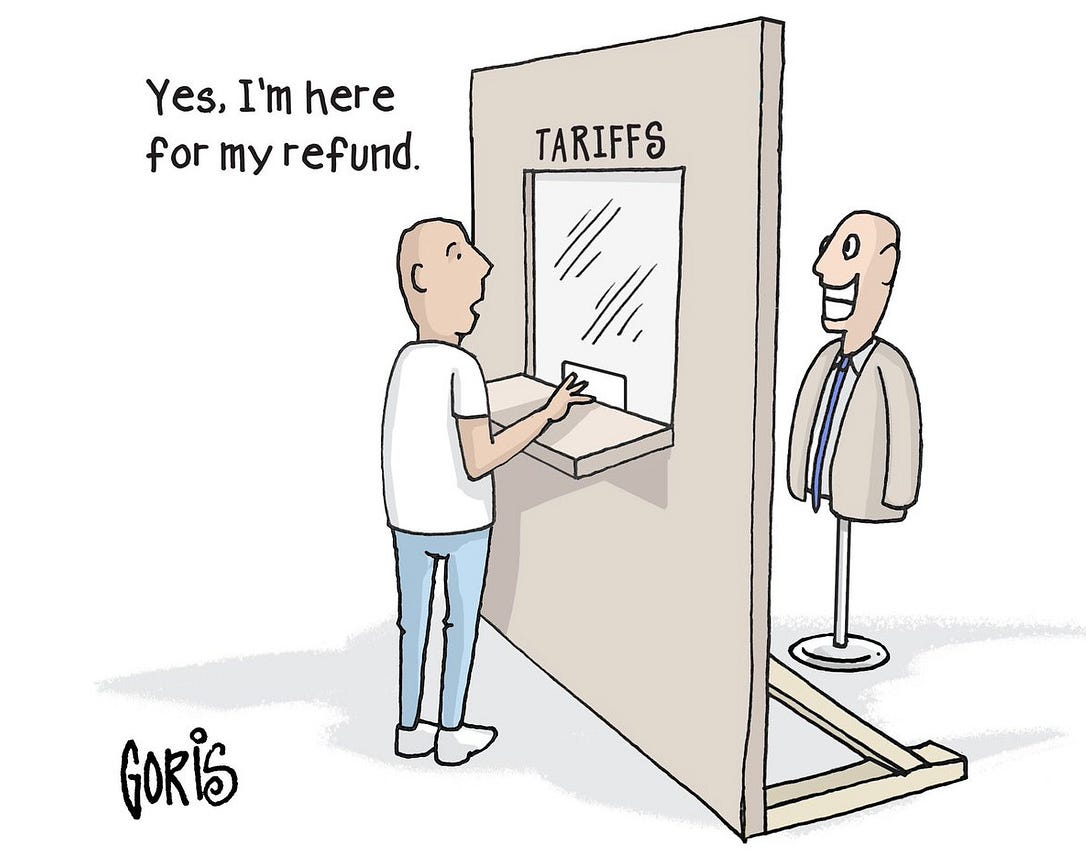
The industry trade groups cited above, along with the states of California and Illinois, are also prepping lawsuits to force the Treasury to return $133B of the $194.9B collected. There are two schools of thought here: one says the money should go to the American consumers who have paid about 90% of the tariffs in the form of higher retail prices. The other says that the money should go to the importers who footed the bill to begin with.
The administration, taking its lead from Justice Brett Kavanaugh’s dissenting opinion, will likely defend a “non-refundable” position. Something that is sure to further ingratiate Trump to the 60% who already disapprove of his governance.
It was a toss-up as whether the President would rail against the Court in very personal terms in his State of the Union address. He’s a guy whose gauge of whether a person is good or not is totally dependent on whether they’re nice to him. DJT is not someone who suffers in silence. We thought he might say terrible things about the three liberals, but save his real ire for his appointees who ruled against him. He continues to think that the Justices owe loyalty to him rather than the Constitution to which they swore an oath. He’s already said they’ve embarrassed their families and the country. It wouldn’t have been surprising to hear him say something super-nasty about Amy Coney Barrett. I was relieved that he didn’t call her “Piggy”.
I know we like to say “what goes up must come down,” but in the cases of consumer goods—from cars to peanut butter—my guess is they’ll defy gravity and stay high. I’m not really going out a limb here. We all know that prices rise easily and decline in leisure, which is to say, slowly, if at all.
Predictably, the right-wing media ecosphere thought the speech was a winner, but mainstream sources from the Wall Street Journal to the USA Today had more realistic takes, calling out the obvious lies and exaggerations.
The world is already moving on from the Trump-imposed economic chaos. Canadians and Chinese nationals no longer need visas to travel between their two countries. Europeans are also welcoming Chinese advances intended to make those two huge economic populations a lot more cozy…without us.
©Jon Sinton
Libertarians huff and they puff, and they blow us all down.
Brilliant analysis. Thanks, Jon. Who among us thinks that those who paid the tariffs, American businesses and consumers, will ever see a dime returned?