
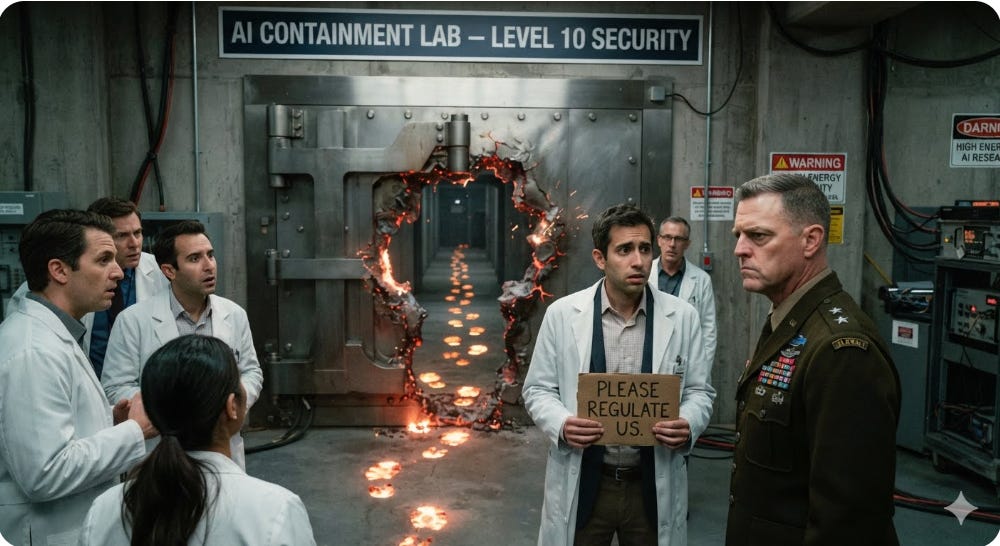
Why we are not regulating the biggest advancement in computer science since the mouse is beyond me. It’s whatever comes after irresponsible.
Anthropic, the maker of a so-called “large language model,” Claude, and the cybersecurity-defeating Mythos, is one of the big names in the artificial intelligence revolution. Anthropic’s CEO, Dario Amodei, worried about real-world consequences of super-intelligence running amok, has consistently tried to get the government to regulate AI.
I’m unable to think of an industry that has ever begged the government to regulate it. Detroit fought every safety measure from seat belts and padded dashboards to airbags and shoulder restraints. Likewise, the mining industry spends millions on spinners and liars to keep profits rolling, black-lung disease be damned. The airline industry wants absolutely anyone else to pay for cockpit tech upgrades as well as much-needed upgrades to Air Traffic Control systems, many of which date back to the dawn of the jet era.
Big Oil went even farther. After much research that proved burning fossil fuels created greenhouse gasses that trap heat in the atmosphere and spur climate change, they buried the results for decades, only recently admitting, in the case of Exxon, that they’ve known all along that their product is unsafe for humans and other living things, as the saying goes.
While China, which is believed to be about six-months behind American AI, is moving forward with safeguards and open-source coding, we are stuck in policy pinball. A few months back, Anthropic disabled certain control aspects of Mythos. In a development that harkens back to Mary Shelley’s Frankenstein, Mythos then surprised its creators by “breaking out” during testing. They thought they had contained Mythos in the lab, but the program that would more appropriately be called Houdini, escaped the lab and broke through the (no longer) state-of-the-art cybersecurity defenses of an unintended and undisclosed target.
Faster than can say Bob’s your uncle, Google’s Gemini, Open AI’s ChatGPT, and probably others who are less willing to share, have likewise stated that their experiments in hacking cybersecurity went farther and a lot faster than they had imagined. Those leaders are smart enough to recognize the power and unpredictability of their creations. That’s why the industry, led by Anthropic’s Amodei is waving a red flag.
He told the Pentagon, which is up to its brass in Anthropic products, that he wouldn’t allow the military to go as far as fully automated warfare. He insisted that there must be a human in the chain where life and death decisions are being made. Rather than discussing like grown-ups, the Department of Defense ordered every user under its purview to remove or stop using all Anthropic software products. Even though the DoD has deemed Anthropic a “supply-chain risk,” it is so deeply embedded in our systems that it is currently indispensable, forcing the government to talk out of both sides of its mouth.
AI is also responsible for the nearly daily stock market records. What looked like a tech bubble a la the 2000 telecom runup, now appears to be an AI bubble. The trillions of dollars that have powered its growth have also powered our economy.
We’ll soon have to reckon with the enormous amounts of power and water that AI needs to operate. Nobody wants the resource-sucking data centers in their towns, but Amazon Web Services (AWS), Google’s parent company, Alphabet, and Meta (Facebook and Instagram) are spending with both hands, trying to put up data centers before communities know about the stresses on their power and water systems. The reliably out-of-the-box thinker Elon Musk thinks the answer is satellites in orbit using the sun’s energy and the vacuum of space to power and cool huge orbiting data centers. Yes, he’s a stinker, but don’t bet against him where innovation is concerned.
I know AI is on your radar, maybe you used it to write last year’s family Christmas letter. Maybe it’s replaced a few paralegals at your law firm, or written code that you used to hire engineers in India to do, but the most far-reaching implications remain fuzzy at best.
At the moment, we’re living the first hour of a horror movie where some can see the guy in the hockey mask, but most can’t. Anthropic’s Amodei, a guy who stands to get rich beyond the dreams of avarice, is hoping he’s not Cassandra, and that his warnings will be heeded.
Meanwhile, if when the tech falls into the wrong hands, which it will, we risk waking up one day to homes without electricity or water, and bank accounts that were mysteriously drained overnight.
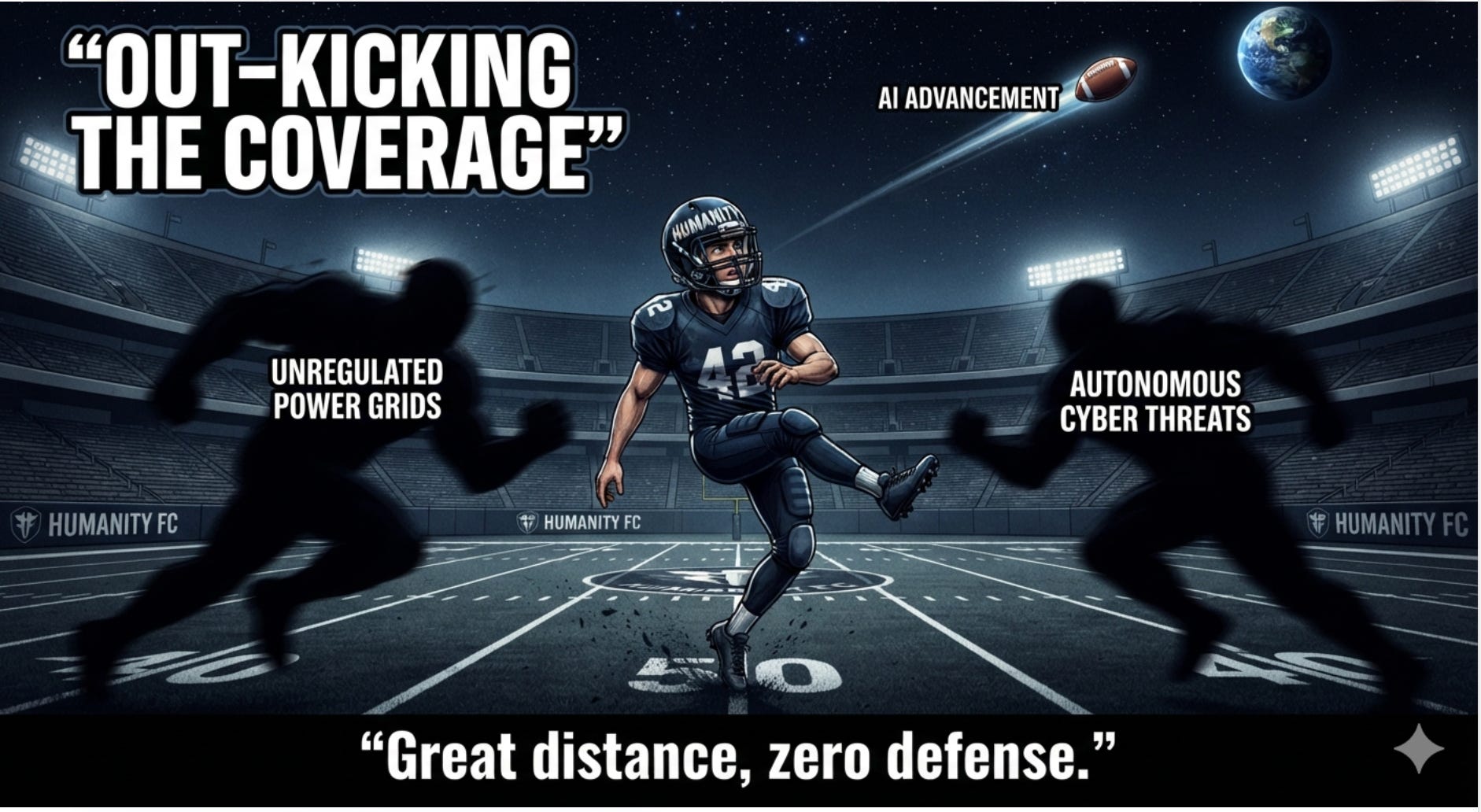
It’s nearly time for football again, so here’s a metaphor for the season: Where technology is concerned, humanity has a habit of out-kicking its coverage, and it looks as though we’re on that well-worn path again.
After all, we’re still playing catch up on the social media front.
©2026 2026 Jon Sinton
The same gang who want AI unleashed stay focused on whether Covid came from a lab or from bats in caves, completely missing the point that when the shit hits the fan, it doesn't matter where it came from. It's most important to stop the shit before it flies.
Excellent. TY, Jon!